
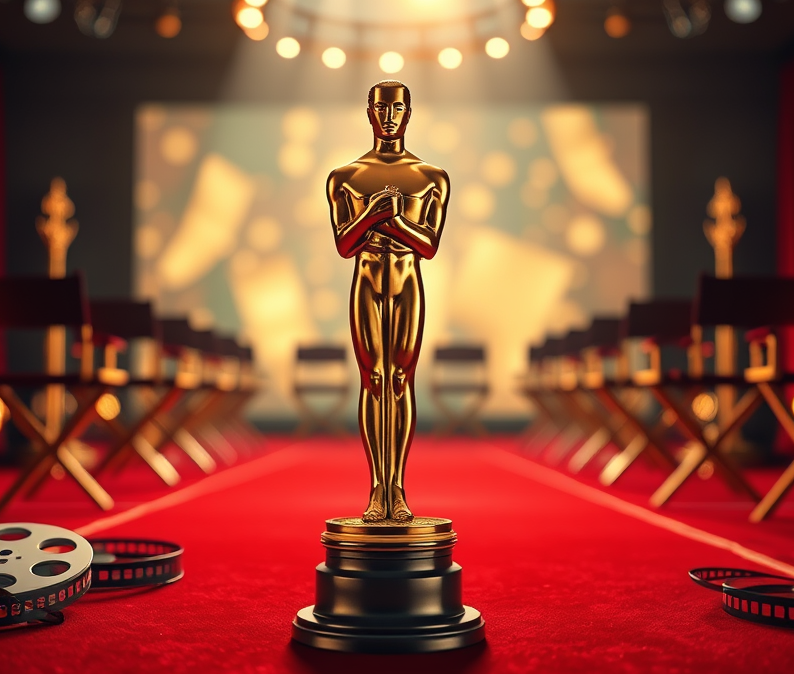

The above AI generated image was created by WordPress tools using the following description.
“Create a meticulously detailed and high-resolution featured image for my blog post. The image should prominently showcase a glamorous Oscar statuette elegantly positioned on a luxurious red carpet. Surround the statuette with elements that symbolize the film industry, such as film reels, director’s chairs, and a softly glowing spotlight. The lighting should create a warm and inviting ambiance, with a soft bokeh effect in the background to convey a celebratory atmosphere. Ensure that the Oscar statuette stands out with sharp focus, capturing all its intricate details and evoking the excitement of the Academy Awards.”
AI is gradually making its way into the film industry. While animation and documentary filmmakers have been pioneers in experimenting with this technology, its adoption is expected to expand beyond these genres. For now, the trend has been to leverage AI to streamline complex workflows associated with film production. This makes sense, as it presents an excellent opportunity to enhance efficiency.
In fact, AI has been utilized in at least three of the Best Picture nominated films this year. “The Brutalist” employed AI voice technology to enhance Hungarian pronunciations and utilized generative AI for architectural visualizations during post-production. “Emilia Pérez” utilized AI voice technology to assist actress Karla Sofía Gascón in expanding her vocal range. “A Complete Unknown” reportedly incorporated AI into its post-production process, specifically for three brief wide shots involving stunt face replacement. “Dune: Part Two” employed a machine-learning model to automate the addition of blue tints to the eyes of actors.
These applications of AI should not cause any concern. How is using AI to achieve more authentic or period-correct pronunciations any different from hiring a dialect coach? Changing eye color used to require contact lenses, but now it’s software. Does it matter?
All industries, including filmmaking, evolve with technological advancements. If they fail to adapt, as Kodak’s demise demonstrates, the consequences can be severe. Sound, color, widescreen, Sensurround (though perhaps not that one), digital cameras, and CGI have all emerged, each providing a new experience while at the same time subtracting something from the old one. Marshall McLuhan once said of technology that, “every augmentation is also an amputation.” Now, we find ourselves at the precipice of AI’s impact.
In the film “The Player,” directed by the master Robert Altman, a scene captures the essence of this technological shift. Film executives convene in a staff meeting, where a newly hired hotshot, Larry Levy, questions the studio’s exorbitant spending on writers. He exclaims, “A million, a million and a half for these scripts? It’s insane!” In response, he proposes a simple yet ingenious solution: pick up a newspaper, read a headline, and voila! You can transform it into a script in a matter of minutes. This scene, written by the novel and film’s writer, Michael Tolkin, was prescient, but he didn’t foresee that technology, not a newspaper, would disrupt the writing room. Fortunately, for now, writers seem to be protected from AI’s encroachment as part of the new contract that ended the strike.
However, the debate between digital and film continues. Digital was touted as the solution to bloating film budgets, akin to Ozempic for film production. However, it soon became evident that the promised cost savings were not as straightforward as anticipated. Film proved to be both costly and challenging to manage compared to digital bits. Nevertheless, digital technology comes with its own set of hidden expenses. A digital camera is not a direct replacement for a 35mm camera, as it necessitates a high-end digital system for editing, data storage, and backups. Moreover, shooting in digital format opens every scene to color grading and provides an opportunity for expensive and time consuming CGI. Directors have increased the shooting ratio, the amount of footage shot compared to what appears on screen, due to the freedom and flexibility digital offers, which means more work for editors.
While the majority of feature films in the U.S. are now shot on digital, with estimates ranging from 70% to 80%, depending on the source, it’s important to note that the demise of celluloid has been greatly exaggerated. For instance, the majority of “The Brutalist” was shot on 35mm film (VistaVision), making it the first full American VistaVision feature since “One-eyed Jacks” (1961). While there were some scenes in “The Brutalist” shot on digital, they were incidental. The film was completed in just 33 days and cost less than $10 million. We still like film.
Without further interruption, here are my picks to win the 2025 Oscars.
Actor in a Leading Role: Adrien Brody, The Brutalist
Actor in a Supporting Role: Kieran Culkin., A Real Pain
Actress in a Leading Role: Demi Moore, The Substance
Actress in a Supporting Role: Zoe Saldana, Emilia Perez
Animated Feature Film: The Wild Robot
Cinematography: The Brutalist
Costume Design: Wicked
Directing: Sean Baker, Anora
Documentary Feature: Porcelain War
Documentary Short Film: I am Ready, Warden
Film Editing: Conclave
International Feature Film: I’m Still Here, Brazil
Makeup and Hairstyling: The Substance
Original Score: Conclave
Original Song: “The Journey” The Six Triple Eight
Best Picture: Anora
Production Design: Wicked
Animated Short Film: Magic Candles
Live Action Short Film: Anuja
Sound: Dune: Part Two
Visual Effects: Dune: Part Two
Adapted Screenplay: Conclave
Original Screenplay: Anora
Leave a Reply